Does not Commute
- 3.9
- Rating
- 10.00M
- Installs
- Free
- Price

 Analysis by App-foxy
At first glance, Does not Commute looks like a small, slightly odd driving game. After spending time with it, I found that its appeal comes from the way several ordinary journeys slowly become one tangled traffic puzzle. It is free, rated for Everyone, and available for Android devices running at least version 8.0, so it is easy to try without making a large commitment. My main advice is to approach it as a thoughtful arcade game rather than as a conventional racing title. You are not chasing opponents around a track; you are building a chain of past driving decisions and then trying to survive the consequences.
That idea gives the game a personality that many mobile racers lack. There is no need to memorize a long list of controls or tune a garage before playing. Instead, each short route asks me to steer a vehicle through a compact setting while watching the clock and avoiding trouble. When the next journey begins, the earlier vehicle returns as a moving replay of what I did. A harmless turn, a wide curve, or an impatient shortcut can become an obstacle for the next driver. The result feels part racing game, part timing challenge, and part quiet experiment in cause and effect.
How the strange commute becomes a playable world
I found the game’s odd premise works best when I stop thinking of each drive as a race and start treating it as a small contribution to a shared traffic pattern. That shift makes the setting feel less like a backdrop and more like a place whose rhythms I can disturb or preserve. It also raises a useful question for the sections ahead: how does a simple route become more demanding once my earlier choices return to the road?
You May Also Like

 Blood Strike: 2.5 Anniversary
Blood Strike’s Loadouts Turn Every Drop Into a Tactical Gamble
A close look at Blood Strike’s custom loadouts: how fast access to signature weapons reshapes its battle royale rhythm, rewards preparation, and narrows the gap between fights.

 Pandora - Music & Podcasts
Pandora’s Music Is Easy to Start, but Harder to Recover
Pandora’s strength is its low-effort path from a seed to a station. Its weak spot is how much confidence it asks you to place in connection, setup, and quiet recovery.

 8 Ball Pool
 Is Built on Rivalries, Rematches, and Routine
A close look at the rivalries, rematches, shared routines, and unanswered safety questions that turn a quick pool match into a persistent mobile community.

 Samsung Music
’s Quiet Strength Is Playing What You Already Own
Its reach comes less from spectacle than from dependable access to a personal library. That simplicity is both the app’s strongest retention engine and its ceiling.

 AccuWeather: Weather Radar
AccuWeather Review: A Quick, Clear Forecast for Everyday Decisions
For everyday plans, the best forecast is the one you can understand quickly. AccuWeather makes rain timing, radar, and local conditions easy to act on, with a few trade-offs.

 Hill Climb Racing
Why Hill Climb Racing Still Turns Crashes Into One More Run
A tiny car, a bumpy hill and one more upgrade: Hill Climb Racing keeps resurfacing because its simple chaos makes every near-miss feel personal.
More From Our News Desk



A first impression built on curiosity
The opening experience is deliberately more intriguing than spectacular. The game presents driving as a series of small scenes rather than one continuous race, and that makes every new vehicle feel like another piece of a larger story. I quickly stopped asking whether I was driving the fastest route and started asking whether the route would remain usable after several more attempts. That change in attitude is important: the game rewards planning and restraint as much as quick reactions.
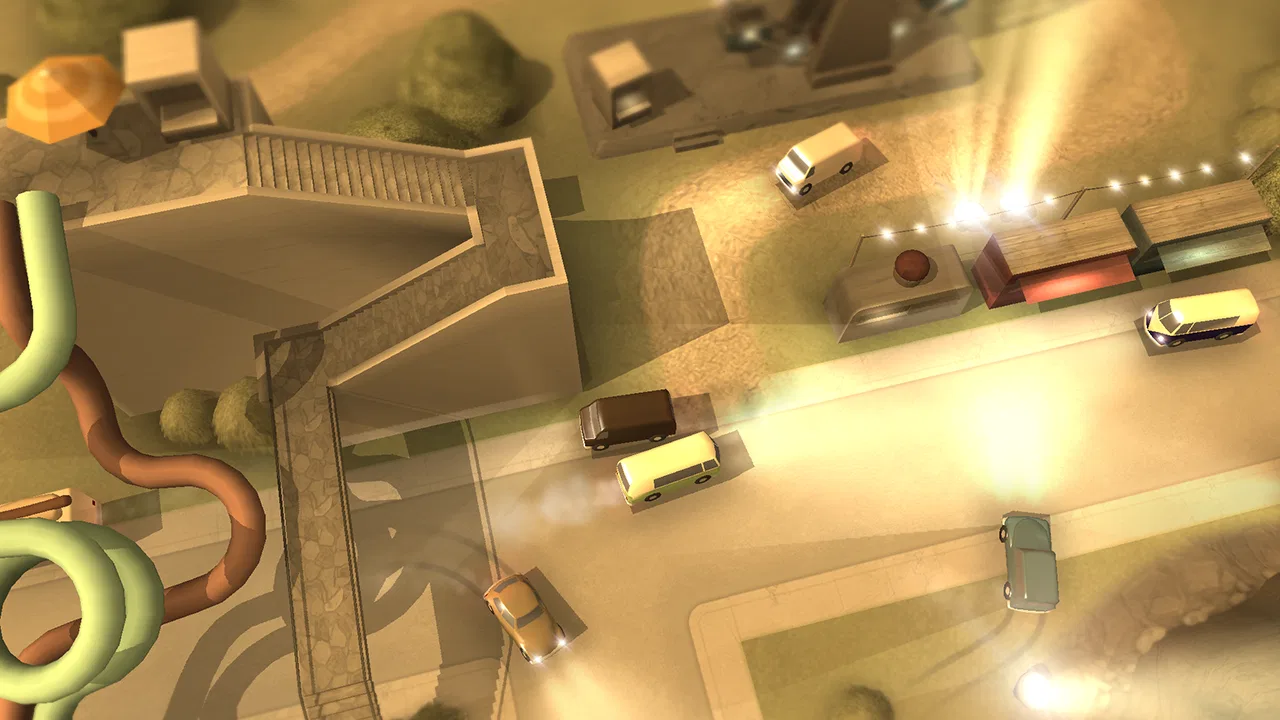
The developer, Mediocre, gives the concept room to breathe. The presentation is stylized and compact, with a miniature quality that makes the roads, buildings, and vehicles feel like parts of a carefully arranged model. It is not trying to imitate a realistic console racer. Instead, the simplified look helps me read the road and understand the growing traffic problem. Even when the screen becomes busy, the visual language stays clear enough to show where I am, what I am approaching, and why a previous decision is now causing trouble.
The setting also helps the unusual time-based structure make sense. This is not a collection of disconnected tracks with unrelated scenery. The journeys feel like movements through one shared place, where different people are heading somewhere at roughly the same time. That connection turns a basic steering challenge into a little urban comedy. A car that seemed unimportant a moment ago may suddenly block a narrow passage, while an earlier turn can create a chain reaction several attempts later.
One of my favorite early discoveries was that the safest-looking action is not always the best one. Driving slowly can make a turn easier, but it also leaves less time for later sections. Taking a corner too aggressively may save seconds and create a crash that complicates every following run. The game therefore makes small choices feel meaningful without burying them under complicated controls. For a short mobile session, that balance is unusually effective.
Visual design that explains the rules
The art direction does more than provide a pleasant backdrop. Its clean, toy-like surfaces separate roads, structures, vehicles, and hazards so I can make decisions quickly. This matters because the game asks me to remember earlier movement while controlling the current vehicle. If the environment were visually noisy, the central idea would become frustrating instead of clever.
The scenes also have a gentle sense of mystery. The vehicles and locations suggest a larger everyday world without requiring long story scenes or heavy exposition. I can invent little explanations for the traffic around me, but the game remains focused on movement. That restraint keeps the atmosphere playful rather than sentimental. It feels like observing a miniature town from above and then being invited to interfere with its routine.
There is a useful contrast between the calm appearance and the pressure underneath. The colors and shapes make the world seem friendly, yet the clock and accumulated traffic can turn a simple road into a tense puzzle. I often found myself smiling at the absurdity of a situation while still concentrating hard enough to avoid making it worse. That combination is one of the strongest reasons the presentation works.
Players who want detailed vehicle models, realistic crashes, or a broad collection of licensed cars may find the visual approach too restrained. The game is not selling speed through technical spectacle. Its strength is readability and character. If you prefer racing games that feel like motorsport broadcasts, this will probably seem modest. If you enjoy stylized worlds where presentation supports a clever rule, the art direction is much easier to appreciate.
Sound that keeps the mood moving
The sound design supports the same unusual balance. It does not overwhelm the screen with constant engine noise or dramatic race commentary. Instead, the audio helps the small journeys feel connected and gives movement a rhythm. The effect is closer to a lively commute than to a championship event, which fits the setting far better than an aggressive soundtrack would.
I noticed that the quieter presentation makes individual mistakes more noticeable. A collision or awkward encounter feels like an interruption to an otherwise orderly routine. That is useful because the game depends on recognizing how a mistake affects the next attempt. The sound does not need to explain the entire system; it reinforces the feeling that the town has a pattern and that I have disturbed it.
The pacing benefits from this restraint. A session can begin calmly, with enough space to learn a route, then gradually become more urgent as vehicles occupy the same roads. The audio helps that escalation feel natural rather than forced. I never felt as though the game was shouting at me to be excited. It lets the traffic and the shrinking margin for error create the tension.
For everyday play, that makes the game comfortable in short bursts. I can play while waiting for an appointment or during a brief break without needing to settle into a long race. At the same time, the atmosphere is distinctive enough that I may continue after the original short session because I want to untangle a difficult sequence. That is a better form of retention than simply demanding longer playtime.
Why the mechanics match the mood
The central mechanic is clever because it turns memory into traffic. Each route is not merely a chance to improve a personal score; it becomes part of the environment for later routes. My previous driving is represented by another moving vehicle, so I have to consider both the current road and the behavior I left behind. This creates a soft form of time travel without making the game complicated to understand.
That structure changes how I drive. In a normal arcade racer, I might cut across a corner because the only concern is reaching the finish quickly. Here, that shortcut can be dangerous when repeated vehicles pass through the same space. I have to think about where my earlier car will be, whether it will cross a junction at the wrong moment, and how much room I am leaving for the next trip. The smartest route is often the one that makes future routes easier, not the one that looks fastest right now.
This is also where the game shows its strongest strategic depth. I began to treat each run as a piece of traffic choreography. A controlled turn could keep a vehicle away from a busy intersection. A deliberate pause could change the timing of a later encounter. I was not simply reacting to obstacles; I was shaping the conditions that my future self would face. That is a surprisingly rich idea for a game with such approachable controls.
The trade-off is that the system can punish experimentation in a way that feels less forgiving than ordinary racing. If I make several careless choices, the road may become difficult because of my own earlier actions. The frustration is fair in principle, but it can still be tiring when I understand what went wrong yet need to repeat several sections to repair it. Players who want instant restarts and constant forward momentum should be aware of this slower, more deliberate loop.
Another useful habit is to avoid treating every vehicle as a separate challenge. I found better results when I watched the whole route and thought in terms of spacing. A turn that is easy for one car may be awkward for another because of timing, position, or the movement left behind by previous attempts. Looking ahead instead of focusing only on the active vehicle makes the game feel less random and reveals more of its design.
The clock adds pressure without turning the experience into a pure speed test. It encourages efficient driving, but the time limit also makes mistakes expensive. This produces a nice tension between caution and urgency. I cannot spend forever arranging perfect traffic, yet rushing creates the very problems I am trying to avoid. The best runs come from finding a practical middle ground: clean lines, sensible timing, and enough awareness to prevent one error from spreading.
How it compares with familiar racing games
Compared with traditional mobile racers, this is a much better fit for someone who enjoys puzzles, planning, and unusual rules than for someone seeking competitive lap times. A standard racing game usually gives me a track, opponents, and a clear goal of finishing first. Here, the challenge is more personal and cumulative. I am competing against my own previous decisions as much as against the road.
It also differs from endless driving games. Endless runners often rely on immediate reflexes and repeated attempts that gradually improve reaction speed. This game asks me to remember patterns and manage consequences. A player who dislikes repeating a route may find the structure frustrating, while someone who enjoys learning a system can find each failed attempt informative.
It is not quite a pure puzzle game either. The vehicles still need to be steered in real time, so the solution cannot be reduced to selecting commands from a menu. That blend is the reason I would recommend it to people who normally avoid racing games but enjoy compact logic challenges. Conversely, racing fans who want customization, realistic handling, or head-to-head competition may be happier with a more conventional alternative in the category.
The free entry point makes trying that distinction easy. The game is listed at no purchase cost, with optional in-app purchases priced at two dollars and ninety-nine cents per item. I would not choose it because of those optional extras; I would choose it for the underlying traffic idea. The important question is whether the time-loop driving feels enjoyable to you, and a few sessions should answer that more clearly than any feature list can.
Practical questions before installing
Device compatibility is straightforward for many current users: the game requires Android 8.0 or newer. It is also marked Everyone, which makes it suitable for a broad audience from an age-rating perspective. That does not mean every player will enjoy it equally. Younger players may appreciate the simple controls and colorful world, while some may need help with the delayed consequences of earlier driving rather than expecting a conventional race.
The game has been available since April 22, 2015, and its current listed version is 1.5.5. Those details matter mainly because this is an established mobile title rather than a brand-new experiment. Its audience is substantial, with more than ten million installs, an average rating of 3.9 from roughly one hundred seventy-three thousand ratings, and around seven thousand written reviews. I read those figures as evidence of broad interest, but not as a guarantee that the unusual structure will suit everyone.
If you are wondering whether it works for short sessions, my experience says yes. A single attempt can be brief, and the compact routes make it easy to stop after a small amount of progress. The deeper challenge appears when you replay sections to improve the traffic pattern, so it can also occupy a longer break. The important distinction is that the game is easy to start but not always easy to finish cleanly.
If you are asking whether it is relaxing, the answer depends on how you respond to self-created problems. The visual style and sound are calm, but the later traffic situations can be tense. I found it relaxing when I accepted that a failed run was information. I found it irritating when I tried to force speed through a route I had not yet understood. Playing patiently is not just good advice; it is the attitude the design rewards.
As for who should skip it, I would point away from it for players who need direct competition, realistic physics, or a large progression system built around unlocking vehicles and upgrades. I would also be cautious if repeated attempts feel like wasted time rather than a way to learn. The game’s best moments come from recognizing patterns and correcting them, so that learning loop has to feel satisfying for the experience to work.
The atmosphere after the novelty fades
What stayed with me was not a particular road or vehicle, but the mood created by the whole system. The art makes the setting feel like a small, readable place. The sound gives each journey a gentle rhythm. The pacing lets calm observation turn into traffic pressure. Most importantly, the mechanics make that atmosphere active: I am not merely looking at a miniature world, I am leaving traces in it that change what happens next.
That coherence is rare in mobile racing. The presentation never feels pasted onto a generic driving template, because the visual and audio choices support the central idea of connected journeys. Even the frustration has a thematic fit. A commute becomes difficult because too many movements overlap, and my own past behavior is part of the congestion. The game turns a familiar everyday situation into something playful and slightly surreal.
My final recommendation is therefore specific. Try it if you want a free racing game that values timing, memory, and traffic planning over raw speed. Give it a short, patient session rather than judging it by the first few minutes. Once the replaying vehicles begin to matter, the design reveals its personality. Does not Commute is not the right choice for every racing fan, but for players willing to trade spectacle for a clever chain of consequences, it creates a memorable and unusually coherent drive.
FAQs for Does not Commute
01What is Does not Commute?
Does not Commute is a time-bending driving game in which you control a series of vehicles traveling through a small town. Each drive is recorded and then replayed as you continue, so your earlier routes become part of the traffic around you. The unusual concept combines careful navigation, quick decision-making, and light puzzle-solving rather than traditional racing.
02How does the gameplay work?
Each level asks you to reach a destination within a time limit while avoiding buildings, obstacles, and other vehicles. After completing one route, your previous run is replayed as a moving vehicle while you control the next one. Because every action remains in the scene, careless driving can create traffic problems, making planning and precision increasingly important.
03Can Does not Commute be played offline?
Yes, the main single-player experience can generally be enjoyed without a constant internet connection, which makes it suitable for short sessions while traveling or when mobile data is unavailable. However, optional features such as advertisements, purchases, updates, or certain device services may require internet access. Availability can also vary depending on the version and platform.
04Is Does not Commute free to download?
Does not Commute is commonly offered as a free download, but the exact monetization model may depend on the Android or iOS version available in your region. The free edition may include advertising or optional in-app purchases, such as an upgrade that improves convenience. It is worth checking the store listing before installing so you understand what is included.
05Is Does not Commute suitable for children and casual players?
The game is easy to understand but becomes challenging as more vehicles and routes are added. Its colorful presentation and lack of realistic violence make it approachable for many players, although younger children may need help with the timing and planning elements. Anyone who enjoys short, strategic arcade sessions should find the controls accessible, while perfectionists may find later stages demanding.
Pros
- Creative time-loop driving concept with a distinctive visual style.
- Short sessions make it easy to play during quick breaks.
- Large cast of quirky drivers adds variety to each run.
- Simple controls are accessible for new players.
- Offline play is convenient when no internet connection is available.
Cons
- Traffic becomes increasingly chaotic and difficult to manage.
- Mistakes can force lengthy retries during later stages.
- Some objectives feel repetitive after extended play.
- Progression may feel slow without careful route planning.
- Ads and optional purchases can interrupt the otherwise smooth flow.

Does not Commute
Gallery